Georgia Okeeffe Art Night Georgia Okeeffe Art Night Cross
F orget the morn glories and orificial irises, with their bellboy readings of flamboyant female sexuality. If there is a painting that encapsulates the mysteries of Georgia O'Keeffe, the subject field of a major forthcoming retrospective at Tate Mod , information technology's of something far more than humble, far less glamorous. A wall with a door in it, an expanse of smooth brownish adobe cored by a rough blackness square of accented negative infinite.
O'Keeffe liked to paint the same thing again and again, until she had penetrated to its essence, unravelling the clandestine of her attraction. The flowers, the antiquated petunias and jimson weed, were superseded by New York cityscapes and so past cow skulls and miscellaneous animal bones, surreally aloft over the clean blue skies and dry striated hills of New Mexico.
This was the landscape that unlatched her heart, and information technology was during her time at that place in the 1930s that she began to captivate over the wall with a door in information technology, located in the courtyard of a tumbledown farmstead in Abiquiú. Offset she bought the business firm, a procedure that took a total decade, and so she set up most documenting its enigmatic presence on canvass, creating almost 20 versions. "I'm always trying to pigment that door – I never quite go information technology," she appear. "It'south a curse the way I feel – I must continually become on with that door."
The attraction was a mystery, and yet walls and doors figure large in the story of O'Keeffe'due south singular life. How practise you lot make the virtually of what's inside you, your talents and desires, when they slam you up confronting a wall of prejudice, of limiting beliefs almost what a woman must be and an artist can do? She didn't kick the wall down – inappreciably her style – but instead gear up her considerable canniness and will at prising a new way through.
In terms of the radical things she did with paint, never listen the innovations she brought to acquit on her private life, she forged a passage to a world of openness and freedom, as frightening every bit it was exhilarating. "I've always been absolutely terrified every single moment of my life," she said, "and I've never permit it stop me from doing a single thing I wanted to exercise."
She was a farm girl get-go, raised in the wide-open prairies of Wisconsin. Her mother had hoped to exist a doctor and several aunts never married, instead pursuing independent careers. The family style was cool and austere, setting great shop by self-reliance. Born on 15 November 1887, O'Keeffe was the eldest girl, ministering to a brood of sisters. Her outset retentiveness was "of the brightness of the light – brightness all around", and she resolved to exist an artist at the age 11.
Indomitable commitment to this ambition got her to the Fine art Institute of Chicago at 17, but all the same her apprenticeship was long. A spell in New York at the Art Students League introduced her to the pleasures of an urban social life, and the concomitant realisation that art would require relinquishment besides equally appetite. "I start learned to say no when I stopped dancing," she said. "I liked to trip the light fantastic toe very much. But if I danced all nighttime, I couldn't paint for iii days."

A downturn in the family fortunes made college an unaffordable luxury. Instead, in common with her contemporary Edward Hopper, O'Keeffe attempted commercial art, though like him she loathed the silliness of the commissions. Equally it ofttimes would in her life, affliction forced a shift in class. She caught measles, and as she was convalescing at abode in Virginia her mother was diagnosed with tuberculosis, and then invariably fatal. Worn downward and despairing, she resolved to carelessness painting birthday.
It was instruction it that saved her, offering a model of a financially independent life. Between 1911 and 1918, teaching was O'Keeffe'south mainstay and anchorage. She took jobs all over the south, living in deep seclusion in South Carolina and out on the Texas Panhandle. The harsh landscape suited her. "I was there before they ploughed the plains. Oh, the sun was hot, and the wind was hard, and you got cold in the wintertime. I was merely crazy about all of it ... The beauty of that wild world."
She cut an extraordinary figure back and so: a rural modernist among the cows, in severe black suits and Oxfords, a man'south felt hat jammed on her black hair. As a teacher in Amarillo she plumped for a hotel frequented past cowboys; in another boarding house she acquired consternation by asking to paint the woodwork black. Careful with her students, she spent much of her private fourth dimension solitary, hiking and camping ground in the canyons, getting loftier on the electrical drama of the prairie sky.
Between jobs, she repeatedly returned to education, studying at the Academy of Virginia and Teachers Higher in New York. The urban center might have been short on cattle drives merely it did offer enrichments of its own. In Manhattan she saw the work of Picasso and Braque and read Kandinsky'southward Apropos the Spiritual in Art.
Fifty-fifty more influential was her introduction to the revolutionary notions of Arthur Wesley Dow: a mild-mannered professor who generated an innovative approach to art. Inspired by Japanese painting, Dow prioritised limerick over imitation, encouraging private aesthetic decision-making, both on the sheet and in ordinary life. Doing things with style: this became the O'Keeffe creed, affecting everything from how she dressed herself and furnished her houses to what she did with her brush.
You learn the lessons, and then you put them into practise, a process that demands intense effort. In Oct 1915, O'Keeffe banned herself from colour, working solely in charcoal. Each nighttime, afterward the long solar day's lessons, she sabbatum on the wooden floor of her room in Columbia higher, Due south Carolina, and tried to set downwards on a sail of paper her most impassioned feelings. She worked right through Christmas, frantic with frustration, until she succeeded in developing a strange new language of abstruse forms, swirling and intertwining similar flames or buds. The Specials, she chosen them: her first authentic, truly independent work.
Picture the young O'Keeffe and y'all conjure ii kinds of images. In the first, she is buttoned upward, reserved, a spartan figure composed of monochromatic parts: white peel, blackness eyes, white shirt, blackness jacket, hands twisted like a flamenco dancer, hair pulled sharply dorsum or hidden beneath a bowler hat. In the 2d, she is categorically unbuttoned, tumbling sleepily out of a white chemise or dressing gown, her breasts and belly bared, witchy locks tumbling over her shoulders.
Both images are the creation of the same man: the lensman and gallerist Alfred Stieglitz, a didactic visionary who helped establish mod art in America. In 1915, a friend of O'Keeffe'south sent him the charcoals without her noesis. Struck, he exhibited them in a group evidence, catalysing 1 of the most fertile art partnerships of the 20th century.
O'Keeffe had showtime encountered Stieglitz at his gallery 291 back in 1908, when she was at the Art Students League. She attended an exhibition of Rodin drawings, finding the erotic content and temper of noisy fence antithetical to her tastes. Later, though, she became enamoured of Stieglitz's artful and an ardent subscriber to Photographic camera Work, his photography mag. While she was horrified to find her own work up on the walls without her permission, the discovery of a kindred spirit who supported her innovations was exactly the boost she needed.
At commencement they wrote: an explosion of letters that carried on unstintingly correct through their lives, numbering a total of 25,000 pages. When O'Keeffe caught Spanish flu in 1919 they were close plenty for Stieglitz to suggest he treat her in Manhattan, though he was married and more than two decades her senior. He visited her sweltering buttercup-coloured studio every day, armed with his camera. Later on a febrile month of this he forced his wife's mitt by bringing O'Keeffe to the marital abode. Emmeline walked in on them mid-photoshoot and promptly threw him out, providing the exit he had craved for years.
Dorsum in Texas, O'Keeffe had foreseen the damage love might practice to her cherished independence, writing to a friend "don't permit it get you Anita if you value your peace of mind – information technology will swallow you up and swallow you whole". Finding a fashion of balancing these countervailing needs would bedevil her for 20 years. Stieglitz supported her painting, but he besides made immense demands on her free energy and fourth dimension, insisting on a frenetic social life that impinged on the calm focus her piece of work required. So there was his insistence on seeing her as a kind of radiantly erotic child-woman, the prototype of feminine truth and virtue. As Roxanne Robinson puts it in her insightful biography, Georgia O'Keeffe: "Like almost, Stieglitz's pedestal was uplifting but would give her piffling room to move."

Oppressive gender stereotypes also afflicted readings of O'Keeffe's work. In 1919, she returned to oil, producing her first flowers as well every bit apples, avocados and other pleasingly rounded forms. Stylised, tightly cropped and enlarged (Stieglitz's photography was an influence, as was the work of her friend Paul Strand), the flowers excited her with their chambers and contours, their frills and fleshy folds, their latent potential for abstract form. But these subtleties were lost on the critics. Primed by an exhibition of Stieglitz's nudes, they saw a revelatory exposé of female sexuality. In her work equally well equally being, O'Keeffe had become an unwilling lightning rod for men'due south constricting ideas about that mysterious creature, the female of the species.
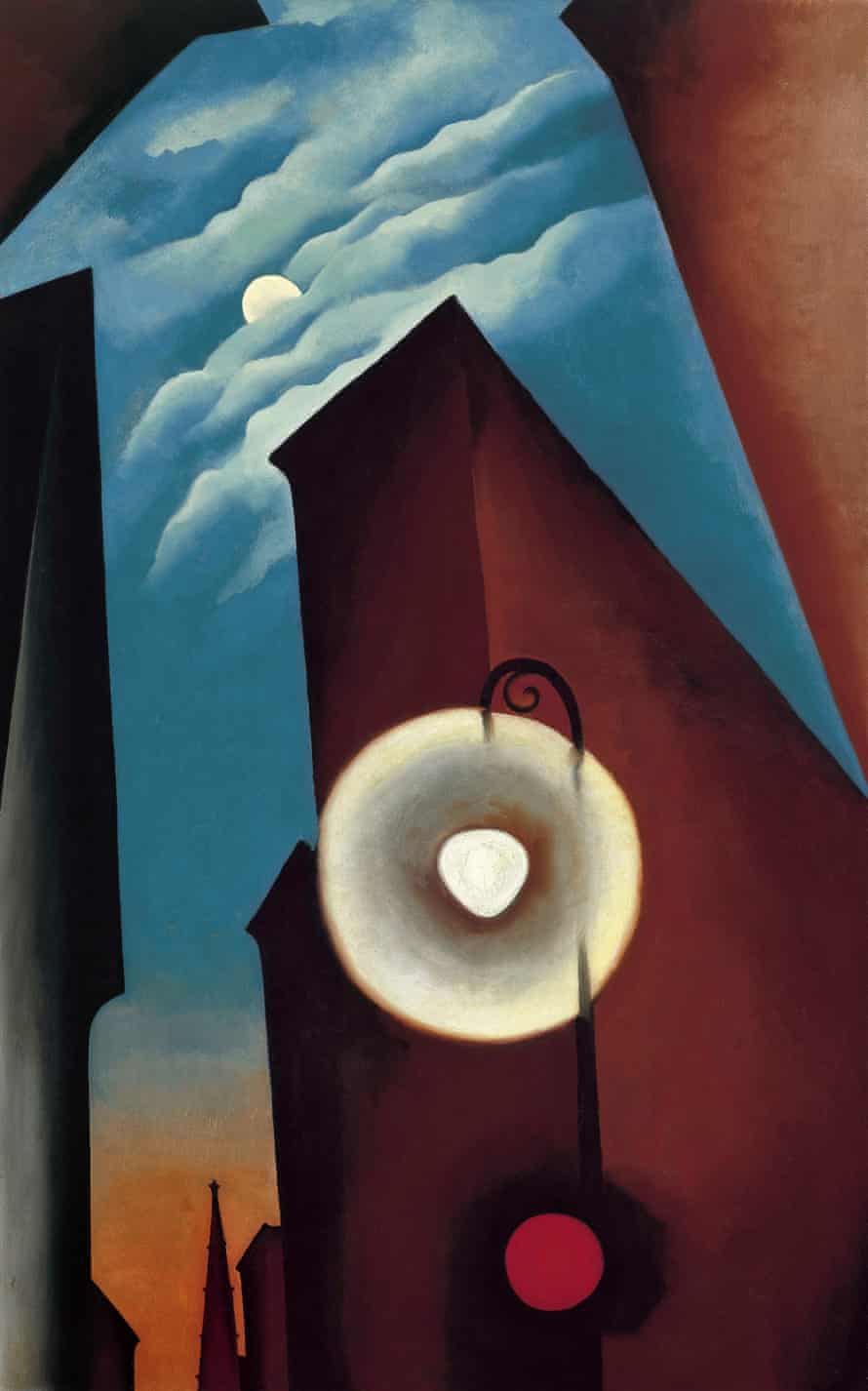
In response, she painted a skyscraper. "When I wanted to paint New York, the men thought I'd lost my heed," she said after. "Only I did it anyway." Her nocturnal streets are peopleless and low-cal-besotted, homing surreally in on sunspots and streetlamp haloes, a minor moon surfing clouds higher up canyons of glowing physical and drinking glass. Everything is smoothed, not painted from life so much as patterned imaginatively, to encode feeling.
The skyscrapers were a triumphant territory grab, but difficulties lay ahead. In 1927, she had surgery for a benign lump in her breast. That same year a adult female began to frequent Stieglitz's new gallery, the Room. Stieglitz, always drawn to pretty girls, began an ill-concealed affair with the married Dorothy Norman, intensifying O'Keeffe's feelings of claustrophobia in their relationship, the strangulating sense of no longer existence the author of her days.
Penned upwards in Manhattan or at Stieglitz'due south family unit dwelling house in upstate New York, she chafed against the mural, the dissonance, the requirements of sociability. Now in that location was the added pain of adultery, the humiliation of betrayal. She began to take increasingly long trips to New Mexico. Separation helped, as did the dizzying, wonderful sense of beingness wholeheartedly committed to her needs, the demands of her taste and talent. All the same, the dearest triangle took a toll, reaching its crunch in 1932.
Walls again. That leap, O'Keeffe was invited to paint a mural in the women's powder room at the new Radio City Music Hall. She agreed to the project despite minimal payment considering she'd long fancied the claiming of painting "big", summoning the largest of her visions. Stieglitz, who loathed public art and liked to tightly control his now married woman's fees, was livid when he heard, co-opting his friends to simultaneously inform O'Keeffe of her idiocy and persuade her to be more friendly to his mistress.
Never one to exist swayed by a crowd, O'Keeffe stuck firm, merely to discover that the plaster of the new building wasn't going to be dry in time. Unable to apply paint, increasingly uneasy, she pulled out, and promptly tumbled into a full-blown breakdown. She couldn't eat and wept for days on end. New York's crowded streets were suddenly appalling, and she became agoraphobic. While her white flowers hung in Stieglitz's gallery, she was hospitalised for psychoneurosis.
At the historic period of 96, O'Keeffe was interviewed by Andy Warhol, some other creator of a purely American colloquial. She told him virtually the landscape that was her nigh cherished dwelling house and bailiwick, the wild expanses of New United mexican states. "I have lived up at that place at the cease of the world past myself a long fourth dimension. You walk around with your affair out in the field and nobody cares. It's nice."
From the beginning, New Mexico represented conservancy, though not in the wooden sense of the hill-dominating crosses she so ofttimes painted. O'Keeffe's salvation was earthy, even pagan, comprised of the cold h2o pleasure of working unceasingly at what you dearest, burning feet away beneath the desert sun.
Back in 1929 she had spent a summertime in Taos with the painter Beck Strand. The pair were taken upwards by a community of powerfully independent women, amid them Mabel Dodge Luhan, the formidable heiress and fine art patron, and the Hon Dorothy Brett, a stone-deaf Englishwoman who carried a knife in her boots. A single scene epitomises the flavour's dykey aesthetics: O'Keeffe and Strand in swimsuits, washing the Ford they'd just learned to drive. In the absenteeism of cloths they polished it with sanitary towels – O'Keeffe was zippo if non enterprising – earlier stripping and giddily hosing each other.

New Mexico was nourishing, but role of its nourishment was the style everything was pared back to essentials, the flab cut abroad. O'Keeffe was getting down to the basic of things, loving the hard, stripped land and the tough, stringent mode it forced her to live. Bones were beautiful, with their apertures and cavities, their bleached resilience. She painted them suspended impossibly confronting the heaven, pinkish and white calico roses tucked coquettishly where ears once were. In 1931 she set a cow skull against draped stripes of crimson, white and blue. As Randall Griffin observes in Georgia O'Keeffe, it was another territory catch, "calculated to provoke and to cast O'Keeffe every bit an emphatically national artist".
After her breakdown, she dispensed with one-half measures. She had compromised emotionally and information technology had near destroyed her; now she would focus on her ain work. Summers were henceforth spent in New Mexico, while the winter's mad socialising went on without her. As a consequence of her increased happiness, things ran ameliorate betwixt her and Stieglitz, though he missed her painfully, bemoaning her absence in long tormented letters. His growing frailty exposed the gulf of years between them, but also the abiding tenderness of their bond. The knack of arranging things in idiosyncratic means may have been O'Keeffe's greatest gift, extending from the structure of her paintings to how she solved the puzzle of reconciling two people's competing needs.
Her base of operations in those years was Ghost Ranch, a dude ranch in Rio Arriba Canton. Initially she rented a room, but every bit her commitment to the identify deepened she bought a pocket-sized adobe business firm. "As presently every bit I saw it, I knew I must have it," she said, adding in a letter to artist Arthur Dove: "I wish yous could see what I see out the window – the earth pink and yellow cliffs to the north – the full pale moon about to go down in an early on morning lavander sky ... pink and imperial hills in front and the scrubby fine deadening green cedars – and a feeling of much infinite – It is a very beautiful globe."
What she liked to do was wait and then retreat, spending days at a fourth dimension deep in the landscape, making sketches in the rear of her Ford. Back in Manhattan for the wintertime, she painted from memory, dispensing with all simply the essentials, trying to capture the centre of it: the smell of sagebrush and cedar, the fashion information technology felt at dusk as if you could climb a ladder right into the sky, the faraway magically nearby.
In May 1946 O'Keeffe had a retrospective at the Museum of Modern Art, the first for a woman creative person. After that summer, Stieglitz was struck by a kind of seizure. When notified by his medico, O'Keeffe elected to remain at Ghost Ranch. He seemed to recover, only to endure a massive stroke. No time to pack. A plane, and then a bedside acuity, taken in turns with the hated Norman.
He died in the small hours of 13 July, and O'Keeffe buried him in a plain pino coffin. It had a pinkish satin lining, and on the night before the funeral she ripped it out and sewed a new one from white linen. An elegant anecdote, though it might be added that she did not cremate Stieglitz with her watercolour Blue Lines, equally he'd asked her to years earlier, and that in the grieving days after his death she rang Norman and banished her from the gallery for practiced.

"As yous come to information technology over a hill, information technology looks like a mile of elephants – grey hills all almost the same size with nearly white sand at their feet," O'Keeffe wrote of the Blackness Place, a remote landscape that inspired her more than any other location. The paintings she made in that location tip geological form over the threshold of abstraction: the serried hills smashed into shards of grayness and puce, bifurcated by yolk-coloured cracks or spills of oily black.
Hills similar elephants sounds an repeat of Hemingway, and there is something of his habits of compression at work in O'Keeffe, a desire to erase everything extraneous, to convey emotion without confessing it directly. She painted very flat, making surfaces so smoothen she in one case compared the sensation to roller-skating. The risk is blandness, simply it can also produce – The Black Place, 1943, say – cleanly assembled structures that quiver with unvoiced feeling.
After she had dealt with Stieglitz's estate, O'Keeffe abased New York, wedding herself to this enigmatic place. She'd bought the Abiquiú firm a few months earlier his expiry, for $10. Information technology took a decade to rebuild, the bulk of the labour washed past her friend and housekeeper Marie Chabot. Finished, it looked and felt similar being inside a trounce. The rooms were kept almost empty, the nun-similar daybed and long stripped table floating in whitewashed space.
Elegance shares a border with crankiness, independence with selfishness, and O'Keeffe was by no means a saint. As she grew older, she became increasingly ornery, battling with friends and staff alike. All the aforementioned, she made a garden in the desert, a fruitful life composed of hard, keen work, i eye always out for a new subject area. Her concluding great serial came in the mid-1960s: the heaven above clouds, a perspective she'd been thrilled to discover from airplane windows. These are the strangest of her paintings, well-nigh artless in their simplifications and cradle-colours, the white clouds floating like lily pads on rapturous expanses of blue and pink.

Live long plenty and you lot might notice yourself the toast of a new generation. In 1970, O'Keeffe was the subject of a substantial retrospective at the Whitney. Over again, the honour was accompanied by a serious blow. "I'd been to town and was going home," she told Warhol. "And I thought to myself, 'Well the dominicus is shining, but information technology looks so grey.'" The greyness was the starting time of macular degeneration, which would claim start her power to paint, and and so her chapters to see.
And and then a stranger came knocking, a beautiful young human, though as in a fairytale he had to try 3 times before he was granted comprisal. Juan Hamilton was 27, a drifter with creative ambitions. Despite the age gap, a closeness developed between them. O'Keeffe doted on Hamilton, encouraging his pottery and allowing him to take increasing control of her finances, her houses and her friendships.
In 1978 she signed an unwitnessed document giving him power of attorney, shortly later which he purchased a mansion and three Mercedes in her name. And when she died on 6 March 1986, at the age of 98, a 1984 codicil to her will revealed that she'd left him the majority of her estate, although all previous wills had prioritised charitable donations.
In the contentious aftermath, an unpleasant story emerged from the firm staff, who said that the day the codicil was signed, O'Keeffe had believed she was marrying Hamilton; that, dressed in white and surrounded by flowers, she had non understood what she was signing. The family went to court, and subsequently complex negotiations Hamilton agreed to hand over a substantial amount of the estate to create the non-profit Georgia O'Keeffe Foundation.
It was a messy end, though what it possibly reveals is the immense command that simplicity, elegance and calm require. Without O'Keeffe's abrupt-eyed, sharp-tongued, exacting presence, chaos loomed. She fabricated it happen, those simple scenes that are anything but, opening a door to a new kind of American fine art, a new kind of adult female'southward life. "Making your unknown known is the near important affair," she said, "and keeping the unknown ever across yous."
Source: https://www.theguardian.com/artanddesign/2016/jul/01/georgia-okeeffe-tate-modern-exhibition-wild-beauty
0 Response to "Georgia Okeeffe Art Night Georgia Okeeffe Art Night Cross"
Post a Comment